
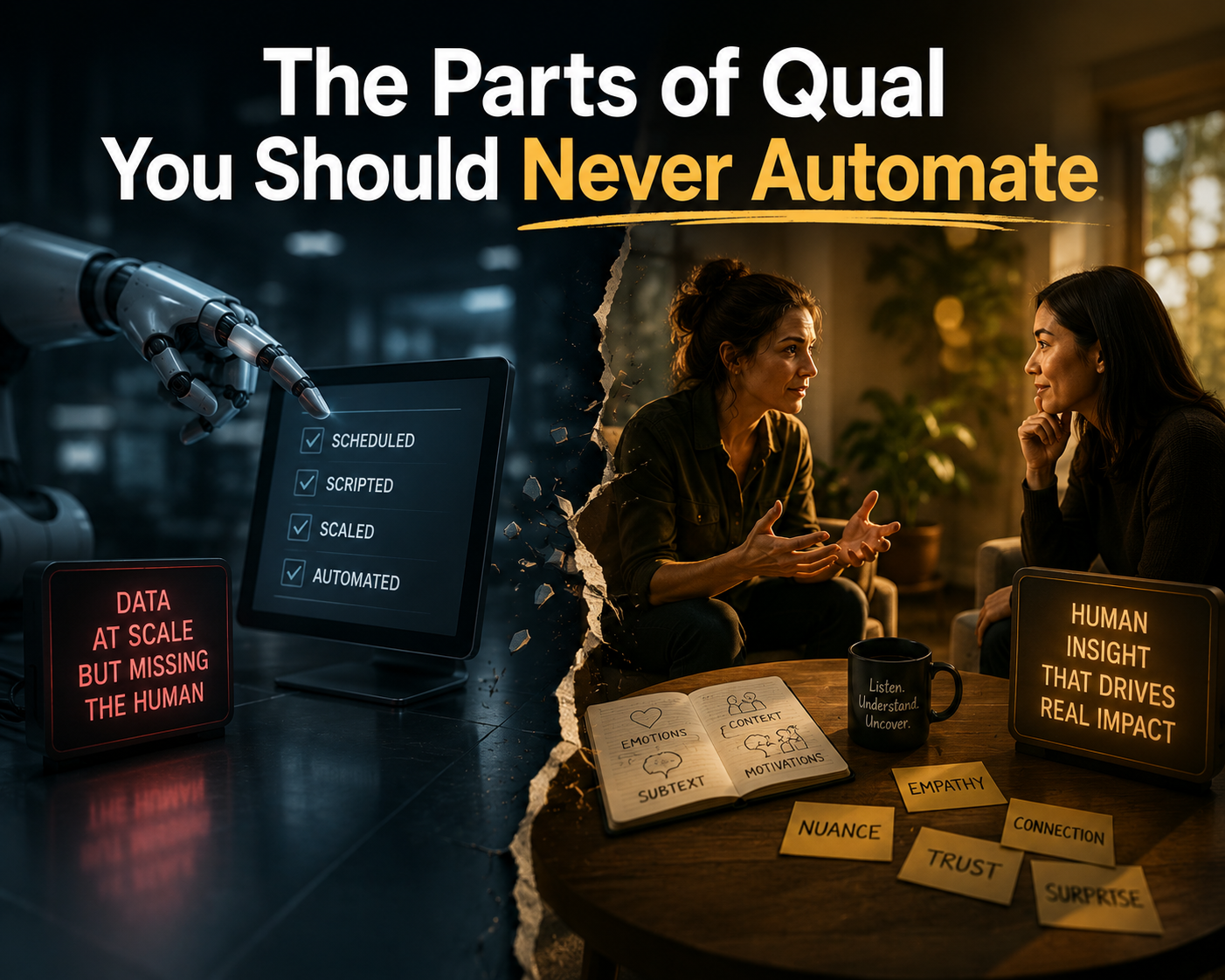
AI is rapidly becoming part of every research workflow.
The real question isn’t “Should we use it?”
It’s “Where does it actually belong?”
Because while AI is powerful, not every part of qualitative research should be handed over to it.
What AI Should Own
There’s no denying the efficiency AI brings.
It excels at:
- Transcription
- Data organization
- First-pass summaries
- Pattern detection across large datasets
These are time-consuming, repetitive tasks that slow researchers down. When AI takes over here, it frees up time for higher-value work.
Think of AI as the efficiency layer the system that handles scale so humans can focus on meaning.
And in that role, it’s incredibly effective.
What AI Should Never Replace
Where AI struggles is where qualitative research becomes truly valuable.
It cannot replace:
- Human-led probing
- Reading between the lines
- Interpreting contradictions
- Understanding emotional nuance
Consumers don’t speak in clean, structured data. They hesitate, contradict themselves, and express things indirectly.
A skilled researcher knows when to pause, when to dig deeper, and when something unsaid is more important than what’s spoken.
AI, by design, smooths complexity.
But qual research depends on embracing it.
The Risk of Over-Automation
The more you rely on AI, the greater the risk of losing depth.
Automated outputs often feel polished and complete. They present clear themes, tidy summaries, and logical conclusions.
But that clarity can be misleading.
What gets lost:
- Edge cases that challenge assumptions
- Emotional intensity that doesn’t translate cleanly
- Contradictions that signal deeper truths
The result is insight that feels right but lacks substance.
And perhaps more dangerously, it creates false confidence.
Defending Depth Without Slowing Down
The solution isn’t to reject AI. It’s to use it deliberately.
You don’t have to choose between speed and richness.
Instead:
- Let AI handle scale and structure
- Let humans focus on interpretation and meaning
This shift allows teams to move faster and go deeper.
It’s not about doing more research it’s about doing better thinking with the research you already have.
From Researcher to Interpreter
As AI takes over execution-heavy tasks, the role of the researcher evolves.
Less time is spent gathering and organizing data.
More time is spent making sense of it.
This requires a different skill set:
- Asking sharper questions
- Bringing in richer context
- Connecting insights to business decisions
The researcher becomes an interpreter not just of data, but of human behavior.
And that role is harder to automate.
Leading, Not Resisting
AI adoption in research is inevitable.
The opportunity for insights teams is not to resist it but to lead how it’s used.
That means defining:
- Where AI adds value
- Where it should be limited
- How outputs are validated and interpreted
Teams that do this well don’t just become more efficient they become more strategic.
They shape how insights drive decisions across the organization.
Closing Thought
The future of qualitative research isn’t human vs. AI.
It’s human-led, AI-supported. Because while AI can process information at scale, it still takes a human to understand what truly matters and why.