
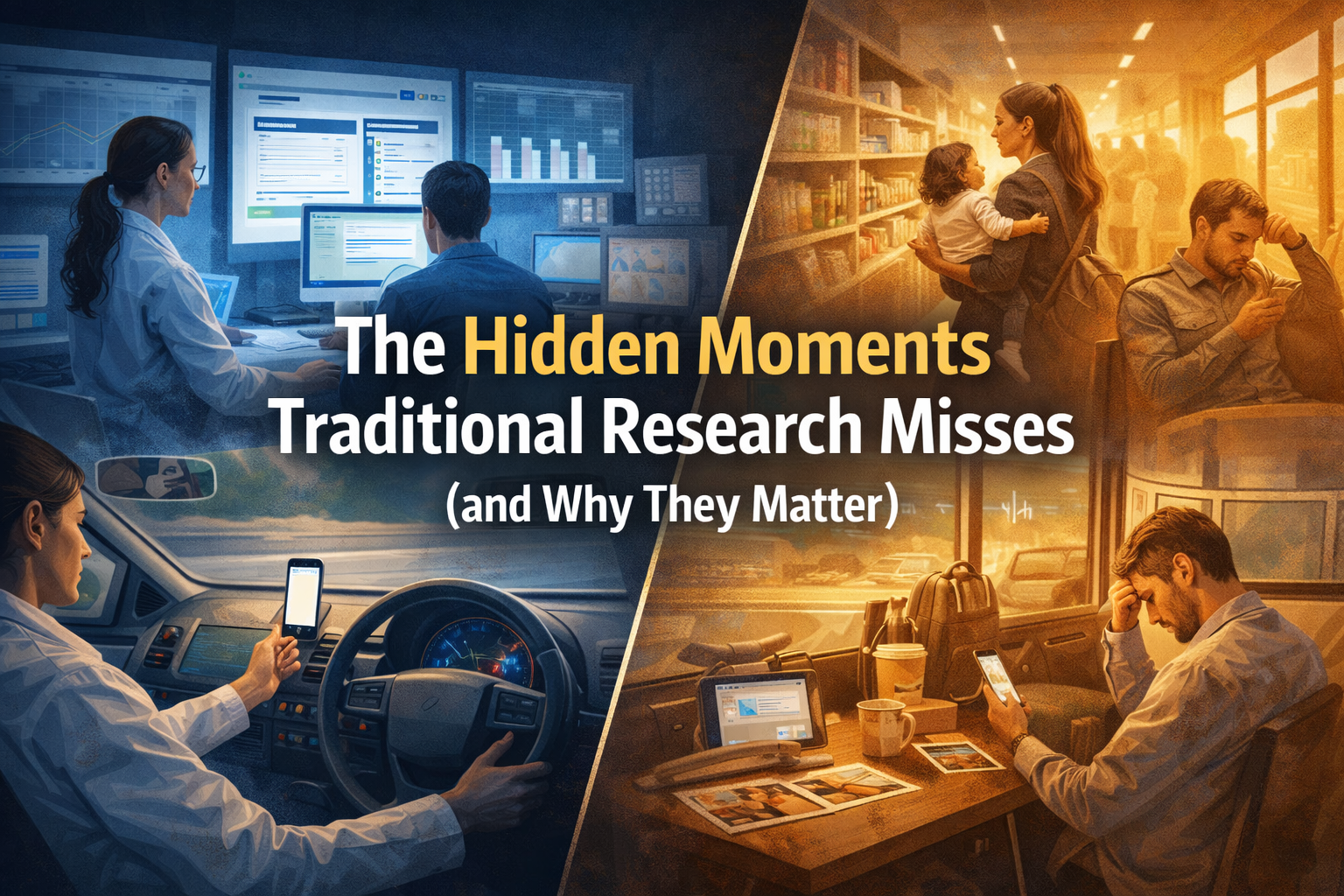
Surveys are structured. Screen recordings feel detailed and precise. Together, they create the comforting sense that we’re seeing the full picture.
But we’re not. Most human behavior doesn’t happen neatly within research environments. It happens in between tasks, outside interfaces, and in moments people rarely think to mention. These are the hidden moments and they are often where the most meaningful insights live.
1. The Illusion of Full Visibility
For decades, organizations have relied on established research methods to understand customers and users. Usability labs, surveys, interviews, and analytics dashboards promise clarity and coverage. When done well, they can absolutely reveal important patterns.
The problem is not that these methods are wrong it’s that they feel more complete than they actually are.
Human behavior doesn’t switch on when a study starts and switch off when it ends. People adapt, improvise, multitask, get distracted, feel pressure, and respond emotionally to situations that never show up in a lab or a questionnaire.
Most real behavior happens:
- Before someone clicks “start”
- After they close the app
- While juggling other responsibilities
- In environments researchers never see
Traditional research captures what people say and do when asked. Hidden moments live in everything else.
2. What Counts as a “Hidden Moment”
Hidden moments aren’t dramatic failures or obvious pain points. They are subtle, easy to miss, and often unspoken.
They include:
- Hesitation before action: the pause before clicking, buying, responding, or committing
- Workarounds and hacks: notes on paper, screenshots, switching devices, asking others for help
- Emotional reactions people don’t articulate: anxiety, doubt, guilt, relief, or frustration that feels “too small” to mention
- Environmental and social context: interruptions, time pressure, noise, family members, coworkers, or public settings
These moments don’t always look like problems. But they shape how people feel and feelings shape decisions.
When research skips these moments, it risks misunderstanding why people behave the way they do.
3. Why People Can’t (or Won’t) Report These Moments
A common assumption in research is that if something matters, people will mention it. In reality, many of the most important moments are the hardest to articulate.
One reason is poor recall. People are bad at remembering micro-behaviors and emotional states, especially when asked days or weeks later. Hesitation, confusion, or doubt fades quickly in memory, even though it may have influenced a decision in the moment.
Another reason is social desirability bias. People want to appear competent, rational, and decisive. Admitting confusion, workarounds, or emotional discomfort can feel embarrassing or irrelevant to them.
Finally, there’s a language gap. People often lack words for instinctive or emotional reactions. They can describe what they did, but not always why it felt off, heavy, or uncomfortable.
As a result, traditional research often captures polished explanations instead of raw experience.
4. What Traditional Methods Miss
When hidden moments go unseen, research misses more than small details—it misses meaning.
First, it misses the “why” behind friction. A task may technically work, but still feel stressful or risky. Without context, friction looks minor. With context, it becomes strategic.
Second, it misses the emotional weight of small issues. A single moment of doubt may seem insignificant, but repeated over time, it can erode trust and confidence.
Third, it misses the context shaping decisions. People don’t make choices in isolation. Time of day, location, social presence, and competing priorities all influence outcomes but rarely appear in reports.
Without these layers, insights remain incomplete and solutions risk addressing symptoms instead of causes.
5. Why These Moments Matter More Than Big Pain Points
Organizations often focus research on major breakdowns: churn, complaints, abandonment, or failures. While important, these are usually the end result of something else.
Hidden moments are often the beginning.
Small frictions compound. A moment of hesitation becomes a delay. A workaround becomes a habit. A quiet emotional reaction becomes disengagement. Over time, these add up to lost loyalty, reduced usage, or abandonment without a single dramatic failure.
Emotional moments, in particular, are powerful. People rarely remember exact features, but they remember how an experience made them feel. Trust, confidence, relief, and anxiety influence whether people return, recommend, or walk away.
Hidden moments explain behavior, not just opinions. They reveal why people act differently than they claim, and why logical solutions sometimes fail.
6. Seeing the Full Experience
To uncover hidden moments, research has to move closer to real life.
This means capturing experiences as they happen, not relying solely on reflection after the fact. In-the-moment methods allow researchers to observe behavior before memory and rationalization reshape it.
It also means letting participants show, not tell. Photos, videos, voice notes, and real-time entries reveal tone, context, and emotion that words alone often miss.
Most importantly, it means moving research out of artificial settings and into everyday environments homes, commutes, workplaces, and social spaces. Real life is messy, and that mess is where insight lives.
When researchers see people in context, patterns emerge that no survey question could have uncovered.
7. Conclusion: Seeing What Matters Most
You can’t fix what you can’t see.
The most valuable insights rarely live in polished responses or perfect tasks. They live between the steps in pauses, workarounds, emotions, and context.
Organizations that learn to see these hidden moments don’t just understand what people do. They understand why it matters. And that understanding is what turns research into meaningful change.