
For years, creative inspiration has followed a familiar path. A brand brief. A set of personas. A deck of trends. A few carefully selected quotes from research. Then the creative work begins often several steps removed from the real people it’s meant to reach.
Today, many CMOs are questioning that model.
In a world where consumers document their lives constantly through photos, videos, voice notes, and messages the most powerful creative inspiration no longer lives in stock libraries or abstract personas. It lives in real consumer moments, captured as life actually happens.
1.The Creative Inspiration Problem
Most creative teams don’t lack talent. What they often lack is proximity to real consumers.
Over time, layers of process have created distance. Personas stand in for people. Segments replace stories. Focus group quotes are trimmed, polished, and stripped of context until they feel interchangeable.
The result? Creative work that is technically sound but emotionally thin.
Personas feel abstract because they are abstractions. “Urban achiever” or “value seeker” doesn’t laugh, struggle, multitask, or change their mind mid-decision. Focus group quotes lack texture because they’re delivered out of context detached from the environments, emotions, and pressures that shaped them.
When creative teams can’t see consumers, they fill in the gaps themselves. And that’s where assumptions creep in.
2. Why Traditional Inputs Fall Short
Traditional research inputs are designed for clarity and consensus but creative work thrives on nuance, tension, and humanity.
First, polished research removes the messiness of real life. By the time insights reach creative teams, they’ve often been summarized, synthesized, and sanitized. What’s left is accurate, but flat.
Second, there’s an over-reliance on assumptions and trend decks. Trends can be useful signals, but they’re not substitutes for lived experience. They tell teams what’s happening broadly, not how it feels personally.
Finally, many organizations suffer from “creative by committee” fatigue. Without a strong, shared understanding of the consumer, feedback becomes subjective. Opinions multiply. Revisions drag on. Creative loses its edge.
What’s missing is a common emotional reference point something everyone can see and feel.
3. The Rise of Consumer-Generated Content
Consumer-generated content is changing that dynamic.
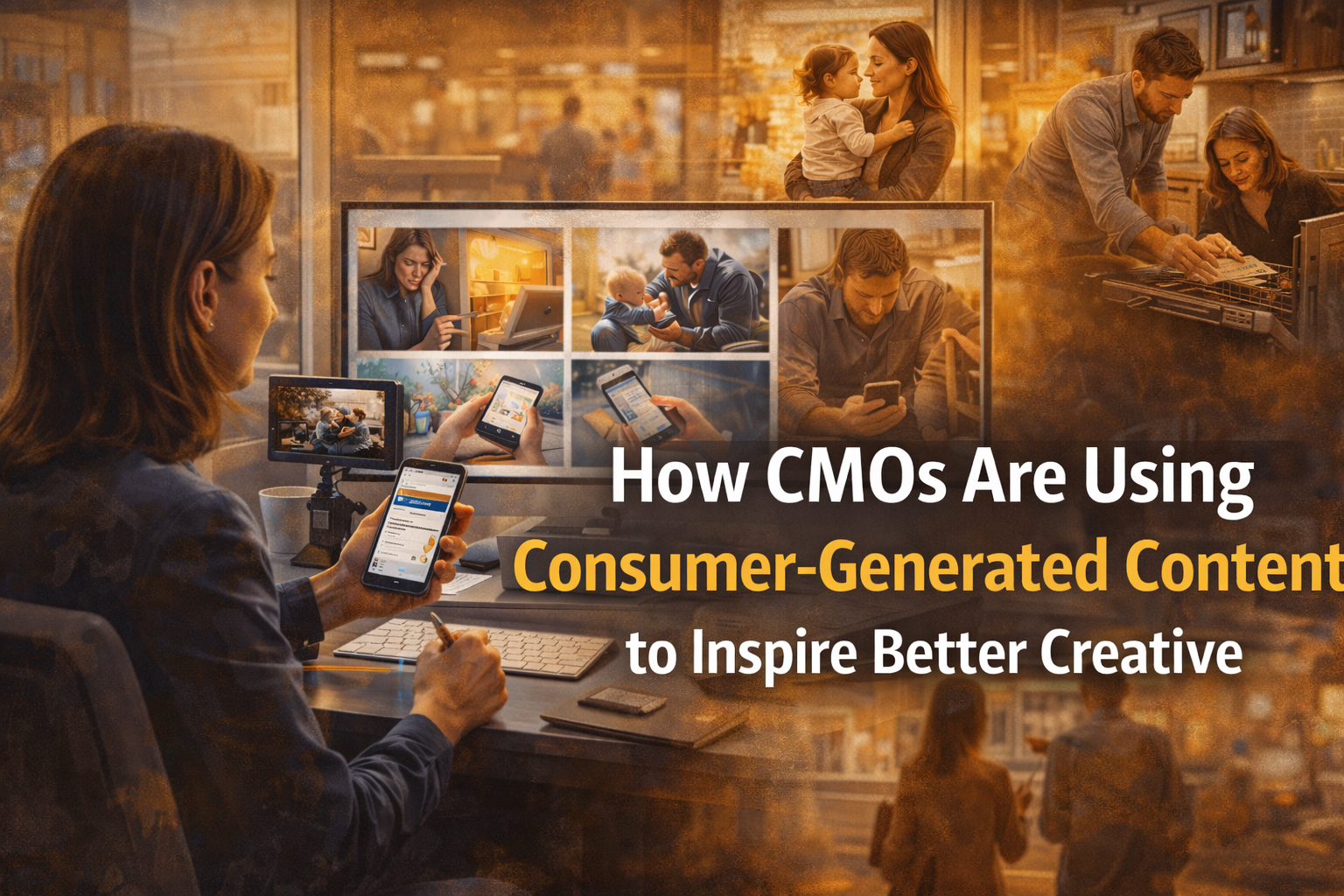
Instead of relying solely on summaries, CMOs are bringing creatives closer to raw, in-the-moment consumer expression: photos, videos, voice notes, screenshots, and diary-style entries captured in real contexts.
This content is:
- Unfiltered: no moderator, no mirror, no performance
- Imperfect: shaky videos, half-finished thoughts, real environments
- Emotionally rich: frustration, joy, doubt, relief all visible, not just described
Importantly, this content isn’t treated as proof or validation. It’s treated as raw material the same way a documentary filmmaker treats footage or a writer treats observations.
Insight becomes something you experience, not just read.
4. How CMOs Are Using This Content
Leading CMOs are embedding consumer-generated content directly into the creative process.
One use is informing messaging and tone. Hearing how people actually speak what words they use, what they avoid, what they laugh at helps brands sound human instead of rehearsed.
Another is inspiring campaign ideas. A single real moment a workaround, a hesitation, a small emotional win can spark an entire creative direction more effectively than a trend report ever could.
CMOs are also using this content to ground creative briefs in reality. Instead of opening with objectives and mandatories, briefs now start with real consumer moments: a short video, a quote with context, a snapshot of real life.
Finally, consumer-generated content is used to pressure-test concepts. Before ideas go too far, teams ask: Does this reflect how people actually behave? Or how we wish they behaved?
That question alone saves time, budget, and creative frustration.
5. Why This Works Better
The impact is noticeable and measurable.
First, authenticity beats aspiration. Consumers are increasingly skeptical of overly polished brand stories. Creative rooted in real life feels believable, not manufactured.
Second, creative teams connect emotionally. Seeing a real person in context creates empathy. It sharpens instincts. Decisions feel less theoretical and more intuitive.
Third, it leads to faster alignment and fewer revisions. When everyone from CMO to copywriter has seen the same consumer moments, feedback becomes more focused. Debates shift from opinion to interpretation.
The work moves faster because the foundation is shared.
6. Rethinking the Role of Research in Creative
This shift requires a rethinking of research’s role.
Traditionally, research has been used to validate creative to test ideas once they’re formed. Increasingly, CMOs are using research earlier, as inspiration rather than evaluation.
That means bringing creatives closer to consumers, not just to insights teams. It means letting them observe behavior, hear emotion, and draw their own connections.
Research doesn’t lose rigor in this model it gains relevance. When insights fuel imagination instead of constraining it, creativity becomes both braver and more grounded.
The wall between “research” and “creative” starts to come down.
7. Closing Thought
The best ideas rarely come from slides.
They come from moments: a pause, a workaround, a laugh, a frustration captured as people live their real lives. CMOs who embrace consumer-generated content aren’t abandoning strategy or insight. They’re giving creativity what it’s always needed most: truth, texture, and humanity. When creative starts with real people, it shows. And more importantly it works.