
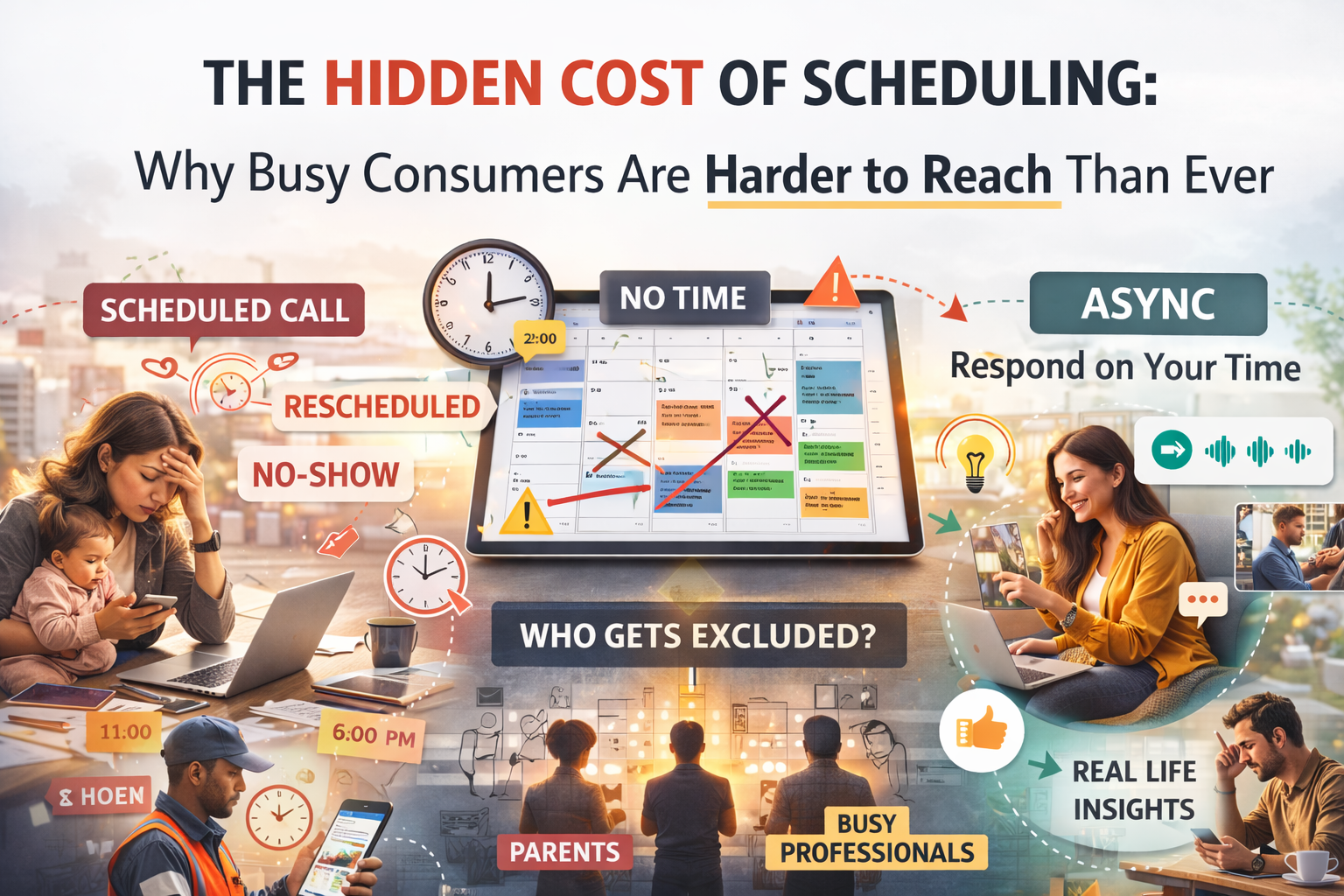
I. The Scheduling Problem No One Talks About
There’s a quiet tension shaping modern research one that rarely appears in methodology discussions but shows up clearly in fieldwork reality.
Participation in live research is getting harder.
Recruiters report rising no-show rates. Calendars fill up weeks in advance. Sessions get rescheduled, shortened, or squeezed between meetings. Participants join calls distracted, camera off, multitasking.
It’s tempting to interpret this as declining willingness. But in most cases, the issue isn’t motivation it’s time.
Live research requires something increasingly scarce: protected calendar space. When participation demands a fixed 60- or 90-minute block, at a specific time, with focused attention, it competes with work deadlines, caregiving responsibilities, commutes, and the unpredictable disruptions of daily life.
And here’s the hidden cost: when research depends heavily on scheduling, it quietly filters out the very people brands often most need to understand.
II. Who We’re Missing When We Rely on Live Sessions
Not everyone has equal flexibility.
Parents and caregivers operate in windows, not blocks. Evenings are chaotic. Weekends are full. A “simple” 7 p.m. session competes with bedtime routines or household logistics.
Shift workers and frontline employees don’t have predictable schedules. Rotating shifts, overtime, and last-minute changes make advance commitments risky. For them, participation isn’t about interest it’s about feasibility.
Young professionals juggling multiple commitments career building, side projects, social obligations often operate in packed calendars. If research participation requires rearranging an already overloaded week, it becomes a luxury.
When research methods prioritize availability over reality, participation skews toward those with flexible time: remote knowledge workers, people with stable schedules, individuals without heavy caregiving loads.
This doesn’t mean their insights lack value. But it does mean we risk over-indexing on certain lifestyles while underrepresenting others.
The result is skewed insight cleaner, calmer, more organized than real life actually is.
III. The Cognitive Load of “Showing Up”
Even when participants do make time, the act of “showing up” carries cognitive weight.
After a day of back-to-back meetings, another Zoom session this time with strangers asking reflective questions can feel draining. Zoom fatigue is real. Burnout is widespread. Attention is fragmented.
Live sessions also introduce performance dynamics.
Participants know they are being observed. They want to articulate clearly. They may feel pressure to sound thoughtful, consistent, even impressive. This can subtly shape responses.
Instead of saying, “I was too tired to think,” they might offer a more polished explanation. Instead of admitting confusion, they may attempt to rationalize.
Live environments can unintentionally encourage optimization participants refining their answers in real time to align with perceived expectations.
Authenticity can get filtered through performance.
IV. Asynchronous Research as a Better Fit for Modern Life
Asynchronous research shifts the equation.
Instead of requiring fixed attendance at a scheduled time, it allows participants to respond on their own time when life creates natural space. A quick voice note after a grocery trip. A short video reflection once kids are asleep. A photo upload during a commute break.
This flexibility aligns research with how modern life actually works.
More importantly, it captures moments closer to when they occur. Rather than reconstructing behavior in a future conversation, participants document experiences in proximity to reality.
Lower pressure often leads to higher authenticity.
Without a live moderator watching, participants may feel more comfortable admitting confusion, frustration, or inconsistency. They can pause, think, re-record, or elaborate without social pressure.
The tone shifts from performance to documentation.
V. Why Asynchronous ≠ Lower Quality
There’s a persistent myth that asynchronous methods are inherently “lighter” or less rigorous than live sessions.
In reality, they often generate richer material.
When participants have time to reflect, responses can become more thoughtful. Instead of answering immediately, they can consider context. They can show their environment rather than describe it. They can revisit a question later with additional detail.
A 60-minute live session captures one slice of time. An asynchronous study unfolding over days captures patterns.
Participants can demonstrate routines across multiple instances morning rituals, evening decisions, repeated frustrations. This longitudinal view often reveals insights impossible to access in a single conversation.
Quality is not determined by synchrony. It is determined by depth, context, and authenticity.
VI. What Researchers Gain by Removing Scheduling
When scheduling barriers are reduced, several benefits emerge.
Higher completion rates. Flexible participation lowers dropout risk. When people can engage at convenient moments, follow-through improves.
More diverse voices. Those previously excluded by rigid timing constraints shift workers, busy parents, overstretched professionals can now participate meaningfully.
Longer engagement windows. Instead of compressing everything into one call, researchers can observe behavior across days or weeks, capturing variability rather than a snapshot.
Better alignment with real behavior. Because responses are embedded in everyday life, insights are grounded in context rather than detached reflection.
Removing scheduling friction doesn’t dilute rigor. It expands representation.
VII. Combining Async and Live for Maximum Impact
This is not an argument to eliminate live research entirely. Rather, it’s an invitation to rethink its role.
Asynchronous diaries can serve as powerful pre-work for in-depth interviews (IDIs). When participants document experiences beforehand, live conversations become more focused and productive. Instead of starting from scratch, moderators can probe specific moments already captured.
In some cases, asynchronous research can replace certain live sessions altogether especially when the objective is to observe routine behavior rather than facilitate discussion.
Hybrid designs often deliver the strongest results: asynchronous exploration to surface real-life patterns, followed by targeted live sessions to unpack meaning.
This approach respects both researcher time and participant reality.
VIII. The Business Impact of Fitting Research into Life
When research aligns with life rather than competing with it, business outcomes improve.
Fieldwork moves faster because recruitment friction decreases. Participation becomes easier to sustain. Studies can scale without overburdening calendars.
Insight coverage improves because more diverse segments are represented. Real-world variability becomes visible. Edge cases emerge alongside mainstream patterns.
Stakeholder confidence increases when findings reflect lived complexity rather than idealized narratives.
Ultimately, reducing scheduling constraints isn’t just a methodological shift it’s a strategic advantage.
IX. Rethinking What “Good Participation” Looks Like
For years, good participation meant attendance: logging in on time, staying engaged for the full session, answering questions clearly.
But in a world defined by busyness, that definition feels outdated.
Perhaps good participation should mean authenticity over availability. Depth over punctuality. Engagement over endurance.
Respecting participants’ time is not a logistical detail it’s a signal of empathy. When research fits into life rather than forcing life to fit into research, the relationship changes.
Participants feel valued, not extracted from.
Researchers gain honesty rather than performance.
And brands receive insight that reflects reality rather than aspiration.
Conclusion
The biggest barrier to quality insight today isn’t unwillingness. It’s time.
Scheduling-heavy methods quietly exclude those living the busiest, most complex lives often the very people shaping category growth and cultural change. By relying too heavily on fixed calendar commitments, we risk hearing from the available rather than the representative.
Asynchronous research offers a path forward. It lowers pressure, expands inclusion, and captures behavior closer to the moment it unfolds. It transforms participation from a scheduled event into a natural extension of daily life.
The future of insight doesn’t belong to those who can carve out an hour on Zoom. It belongs to those designing research that respects reality.
When we remove the hidden cost of scheduling, we don’t just improve participation rates we improve the truth of what we learn.