
I. The Problem with “Big Picture” Research
For decades, research has prioritized the “big picture.” We ask consumers to summarize their preferences, describe their typical behaviors, and explain their decision-making processes in neat narratives. We analyze averages, segment profiles, and journey maps that smooth complexity into clarity.
But life doesn’t happen in summaries.
Most traditional research relies heavily on memory. We ask participants to recall what they did, why they did it, and how they felt often days or weeks after the moment has passed. Memory, however, is not a recording device. It is reconstructive. It fills gaps, edits inconsistencies, and reshapes events into stories that make sense.
In hindsight, friction gets softened. Impulses get rationalized. Emotional reactions are reframed as logical choices.
When someone says, “I chose that because it was better value,” the real driver may have been fatigue, habit, or convenience. The big picture often hides the truth of the small moment.
If we want better insight, we must shift our focus from summaries to slices of life.
II. What Are Micro-Moments?
Micro-moments are brief, everyday instances that influence decisions and behaviors. They are small in duration but significant in consequence.
They include moments like:
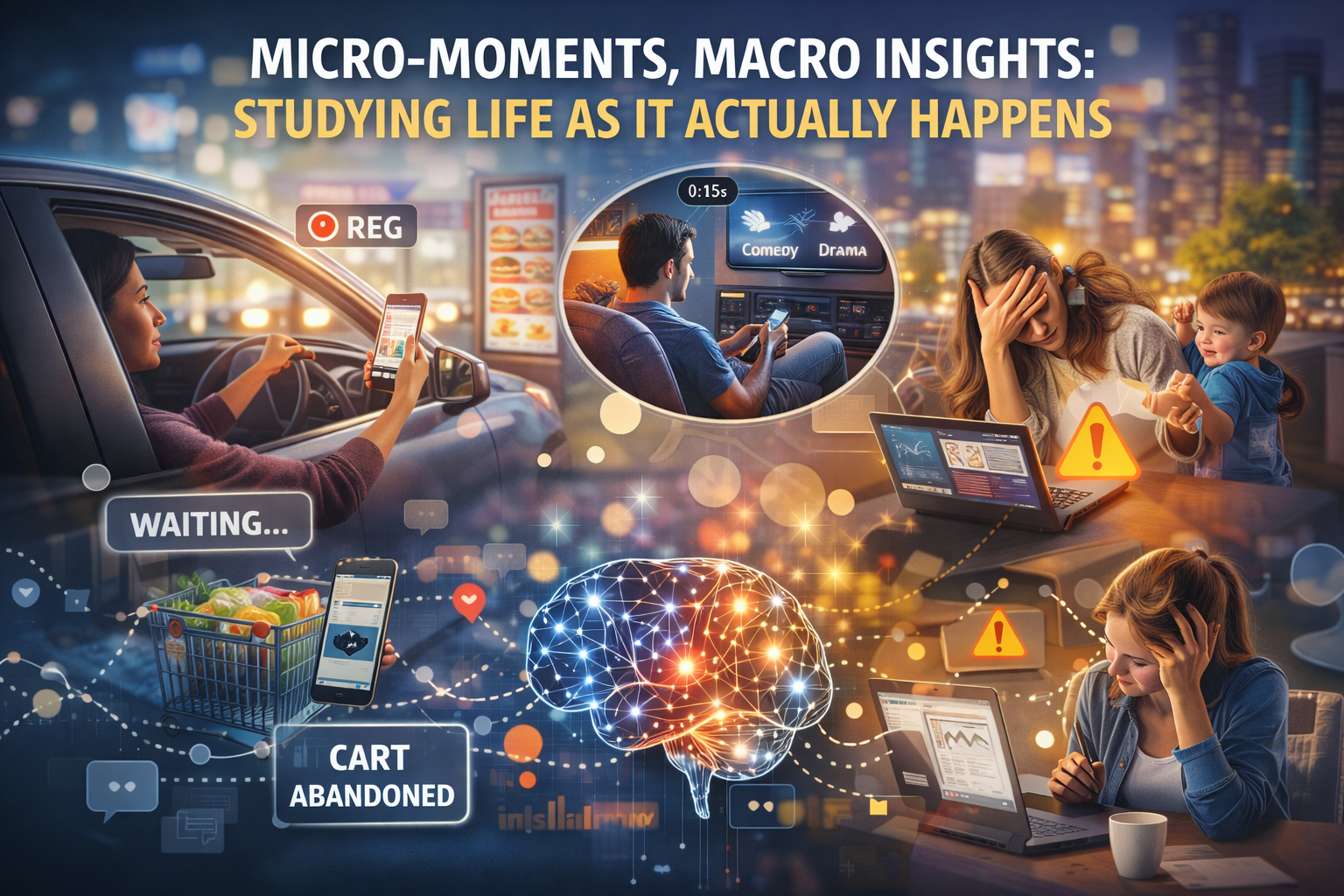
- Choosing a drink at a drive-thru while cars line up behind you
- Deciding what to watch late at night after scrolling endlessly
- Adding items to an online cart then abandoning it
- Skipping a task because it feels too complicated or you’re simply too tired
These moments rarely feel monumental. Consumers don’t label them as “decision points.” Yet collectively, they shape habits, brand relationships, and long-term loyalty.
Micro-moments are where intention meets reality.
They are shaped by context time pressure, environment, mood, social presence, cognitive load. They are often fast, automatic, and emotionally charged. And because they are fleeting, they are easy to forget or misremember.
But they are precisely where strategy lives or dies.
III. Why Micro-Moments Matter More Than Consumers Realize
Most decisions are not made through careful deliberation. They are made on autopilot.
Behavioral science consistently shows that emotional state influences action more than conscious logic. A stressful day increases the likelihood of convenience purchases. Fatigue reduces willingness to compare options. Time pressure narrows attention.
Consumers rarely articulate these drivers because they operate beneath awareness.
Small frictions an extra login step, unclear labeling, a slow-loading page seem minor in isolation. But repeated across dozens of micro-moments, they compound into significant behavioral shifts. A user doesn’t abandon a brand because of one inconvenience. They drift away because of many small ones.
Likewise, small delights a reassuring message, intuitive packaging, a quick checkout build cumulative positive sentiment.
Micro-moments are the building blocks of experience. Ignore them, and you misunderstand the whole.
IV. How Traditional Research Misses These Moments
Traditional research methods struggle to capture micro-moments for three primary reasons.
Time lag. By the time an interview takes place, the emotional charge of a moment has faded. What remains is a reconstructed version shaped by reflection.
Rationalization. Humans are meaning-making creatures. When asked why they did something, they generate plausible explanations even if those explanations were not the true drivers at the time.
Social desirability bias. People want to appear thoughtful, rational, and consistent. Admitting “I was too tired to think” feels less acceptable than saying “I evaluated my options.”
The result? We study narratives rather than behavior.
And while narratives are useful, they rarely reveal the messy, human reality of real-time choice.
V. Capturing Micro-Moments in Real Time
To understand micro-moments, research must meet people where life happens.
This means designing short, lightweight tasks triggered by real-world experiences. Instead of asking someone to describe their weekly grocery routine, we prompt them to record a quick voice note while standing in the aisle. Instead of discussing streaming habits in abstract, we ask for a short video explaining why they chose or skipped a show in that exact moment.
Video, photo, and voice capture allow emotion, environment, and context to come through.
The key is minimal disruption. Micro-moment research should not feel like homework. It should feel like documentation. A 30-second reflection. A snapshot. A quick screen recording.
When done well, it preserves the authenticity of the moment rather than replacing it with performance.
VI. Turning Small Moments into Big Insights
Individual micro-moments are interesting. Patterns across micro-moments are transformative.
When researchers analyze repeated instances across participants, themes emerge:
- Friction points: Where do people hesitate? Where do they give up?
- Delight triggers: What sparks unexpected satisfaction?
- Workarounds and hacks: How do people compensate for poor design?
A single abandoned cart may not mean much. Dozens of videos showing confusion around delivery fees tell a different story.
Repeated late-night scrolling sessions revealing exhaustion and overwhelm highlight unmet needs around curation and simplicity.
Micro-moment analysis shifts insight from anecdote to pattern. It surfaces needs that consumers may never articulate directly because they experience them as normal parts of life.
When friction is normalized, it goes unreported unless captured in real time.
VII. Real-World Applications
Micro-moment research has broad application across industries.
Retail & QSR: Decision-making under time pressure reveals how menu design, promotions, and store layout influence fast choices. The difference between aspiration and actual purchase is often visible within seconds.
Media & Entertainment: Choice overload, content fatigue, and second-screen behavior emerge clearly in late-night selection moments. Observing scrolling patterns reveals more than asking about favorite genres.
Financial Services: Avoidance behaviors, confusion with terminology, and trust signals show up in small pauses and tone shifts. Micro-moments reveal where anxiety overrides intention.
Parenting & Caregiving: Emotional strain and logistical juggling shape product use in ways surveys cannot capture. Watching a caregiver multitask during a hectic evening provides more actionable insight than a retrospective description.
Across categories, the pattern is the same: context shapes behavior.
VIII. Why Micro-Moment Research Drives Better Decisions
When organizations understand micro-moments, they design with empathy.
They prioritize fixes based on observed friction rather than assumed pain points. They simplify processes that consistently create hesitation. They amplify elements that reliably spark positive emotion.
Micro-moment insight also strengthens storytelling. Stakeholders respond to real, contextualized evidence. A short clip of a frustrated user communicates urgency more effectively than a bar chart.
Strategic decisions become grounded in lived experience rather than abstract metrics.
Instead of asking, “What do customers say they want?” teams begin asking, “What is happening in the moments that matter?”
That shift changes product roadmaps, communication strategies, and service design.
IX. The Shift from Studying “Users” to Studying Lives
Perhaps the most profound implication of micro-moment research is philosophical.
Consumers do not experience brands in isolation. They encounter them amid distractions, obligations, emotions, and competing priorities. A shopping app competes not only with other apps but with children asking questions, work notifications, and mental fatigue.
Studying “users” in isolation strips away that reality.
Studying lives acknowledges it.
When research reflects how people actually live fragmented, multitasking, emotionally dynamic strategy becomes more grounded. It accounts for imperfection. It anticipates friction. It designs for real-world constraints.
Micro-moments remind us that big decisions are rarely grand events. They are accumulations of small, contextual choices.
Conclusion
Big strategies are built on small moments.
By shifting our focus from broad summaries to real-time experiences, we unlock a more accurate, empathetic, and actionable understanding of behavior. Micro-moments reveal the hidden drivers of choice—fatigue, time pressure, habit, emotion—that traditional research often overlooks.
Capturing life as it actually happens changes the quality of insight entirely. It replaces reconstructed narratives with lived reality. It transforms minor friction into strategic opportunity. And it reframes consumers not as abstract “users,” but as people navigating complex, dynamic lives.
In the end, macro insight does not come from asking bigger questions. It comes from paying closer attention to smaller ones.