
I. Mobile Ethnography Isn’t New—So Why Now?
Mobile ethnography has been around far longer than many assume. Early versions appeared in the form of SMS-based diaries, digital photo journals, and even clunky app-based logging tools in the late 2000s. Researchers saw the potential immediately: what if participants could document their lives as they lived them, rather than recalling them days later in a focus group?
And yet, adoption lagged.
The technology often felt like more work than insight. Participants struggled with uploads and battery life. Researchers were overwhelmed by unstructured data photos, videos, text entries with no easy way to synthesize patterns. Stakeholders were skeptical. “Interesting stories,” they’d say, “but where’s the proof?”
For years, mobile ethnography was technically possible but not truly practical.
Today, that distinction has disappeared. Smartphones are more powerful, connectivity is seamless, and digital participation is second nature. What once felt experimental now feels intuitive. The infrastructure has matured, and so has the appetite for real-world behavioral data. The moment didn’t arrive because the method is new. It arrived because everything else finally caught up.
II. The Smartphone as a Behavioral Sensor
The modern smartphone is more than a communication tool. It’s an always-present behavioral sensor.
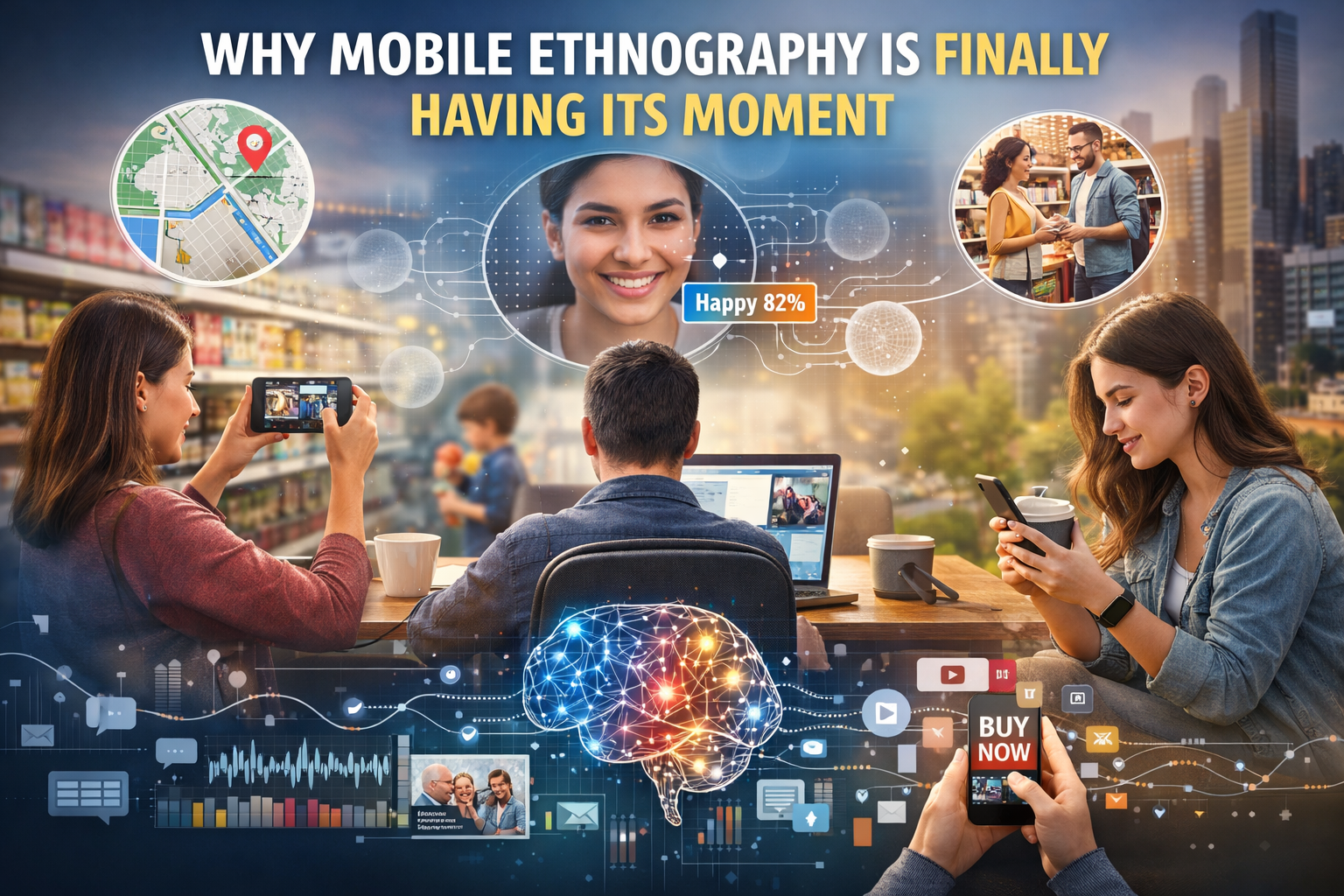
It knows where we are. It documents who we’re with. It captures our environment through video, audio, and imagery. And because it is embedded in daily life, it records behavior in context not in artificial settings.
Through mobile ethnography, researchers can observe:
- Environment: Where decisions happen at the shelf, in the car, on the couch.
- Emotion: Tone of voice, facial expression, energy levels.
- Context: Competing distractions, social influences, real-time constraints.
This matters more than ever because modern consumption is fragmented. Decisions are made in between meetings, while multitasking, during hybrid workdays, or in micro-moments of downtime. Traditional research methods often strip away this complexity. Mobile ethnography captures it.
When participants film a grocery decision or narrate a late-night streaming choice, they aren’t reconstructing behavior they are revealing it.
III. Cultural Shifts Driving the Moment
The rise of mobile ethnography is not only technological. It’s cultural.
Life is faster, messier, and less scheduled than ever. Hybrid work has blurred the boundaries between home and office. Parents toggle between caregiving and conference calls. Consumers scroll, shop, compare, and consume simultaneously.
Multitasking isn’t an exception it’s the norm.
Traditional research methods struggle in this reality. Asking someone to attend a 90-minute focus group about their “typical day” assumes there is such a thing as typical. It assumes clarity and reflection that may not exist.
Meanwhile, culturally, people are more comfortable documenting their lives. Social platforms have trained us to show rather than tell. A short video, a snapshot, a voice note these feel natural.
Participants today are often better at demonstrating behavior than explaining it. When asked, “Why did you choose that brand?” they may rationalize. When asked to show the moment they chose it, the truth emerges: convenience, habit, frustration, price, influence from a partner standing nearby.
Mobile ethnography fits how people already communicate.
IV. What Mobile Ethnography Reveals That Other Methods Miss
One of the most powerful contributions of mobile ethnography is its ability to close the gap between stated behavior and actual behavior.
In surveys and interviews, people describe who they think they are. In mobile ethnography, we see who they are in action.
It reveals:
- Invisible decision-making moments: The hesitation before adding to cart. The product picked up and put back. The quick text asking a spouse for input.
- Micro-emotions: The sigh when an app glitches. The smile when packaging feels premium.
- Unconscious drivers: Habitual routes through a store. Automatic brand grabs without comparison.
These moments rarely surface in recall-based methods. They are too small, too fleeting, or too automatic.
Yet these micro-moments often drive macro outcomes.
Mobile ethnography also captures contradiction. A participant may claim to value health-conscious choices but document repeated convenience-driven purchases. Rather than exposing dishonesty, this reveals tension between aspiration and reality. And tension is fertile ground for insight.
V. Why Researchers Are Embracing It Now
Beyond cultural readiness, practical advantages are accelerating adoption.
First, asynchronous participation fits real life. Participants no longer need to block time for a live session. They contribute in moments that make sense after school pickup, during a commute (safely, of course), or while cooking dinner.
Second, engagement improves when participants feel in control. Mobile ethnography shifts power dynamics. Participants decide when and how to document their experiences. This autonomy often leads to richer, more authentic storytelling.
Third, video has transformed qualitative research. A two-minute clip can convey nuance that pages of transcript cannot. Body language, environment, interruptions all add texture.
For stakeholders, this visual storytelling is powerful. It humanizes data. It bridges the gap between insight and empathy.
What once felt messy now feels immersive.
VI. The Role of AI in Making Mobile Ethnography Scalable
Historically, one of the biggest barriers to mobile ethnography was analysis overload. Hours of video. Hundreds of photos. Thousands of text entries. Insight was buried in abundance.
Artificial intelligence has changed that equation.
AI tools can now:
- Automatically transcribe and tag video content.
- Identify recurring themes across participants.
- Cluster behaviors and emotional cues.
- Surface anomalies and outliers.
Importantly, AI does not replace the researcher’s interpretive role. It accelerates organization and pattern recognition. It reduces mechanical workload so researchers can focus on synthesis, storytelling, and strategic framing.
The result is scale without sacrificing depth.
Mobile ethnography is no longer limited to small, boutique studies. It can operate across larger, more diverse samples while maintaining contextual richness.
VII. When Mobile Ethnography Works Best (and When It Doesn’t)
Like any method, mobile ethnography is not universally optimal.
It works particularly well for:
- Daily routines: Morning rituals, meal preparation, commuting habits.
- Shopping journeys: In-store decisions, online browsing, cart abandonment.
- Media consumption: Second-screen behavior, content switching, co-viewing.
- Caregiving and parenting: Real-time stressors, work-life negotiation, product use in context.
These are behaviors embedded in real environments and influenced by competing forces. Capturing them live provides clarity.
However, traditional methods still have value.
Strategic concept testing may benefit from moderated discussion. Sensitive topics may require live facilitation to build trust. Complex co-creation workshops may demand synchronous collaboration.
Mobile ethnography excels at observing life as lived. It is less suited to structured evaluation or high-energy ideation sessions.
The smartest research designs combine methods rather than replace them.
VIII. What This Means for the Future of Qual
The growing prominence of mobile ethnography signals a broader shift in qualitative research.
We are moving from episodic studies snapshots in time to ongoing understanding of lived experience. Instead of asking participants to reconstruct their week, we accompany them through it.
We are moving from recall-based insight to real-world truth. From controlled environments to contextual immersion.
And perhaps most importantly, we are redefining what rigor looks like in qualitative research. Rigor is no longer about polished transcripts alone. It is about capturing behavior in its natural habitat and analyzing it systematically.
Mobile ethnography is no longer a “nice-to-have” add-on. It is becoming a core method for brands and organizations seeking to understand complexity at scale.
The alignment of culture, technology, and analytical capability has created a rare moment. The tools are ready. Participants are ready. Stakeholders are ready. Mobile ethnography isn’t new. But for the first time, it fits the world we actually live in.