
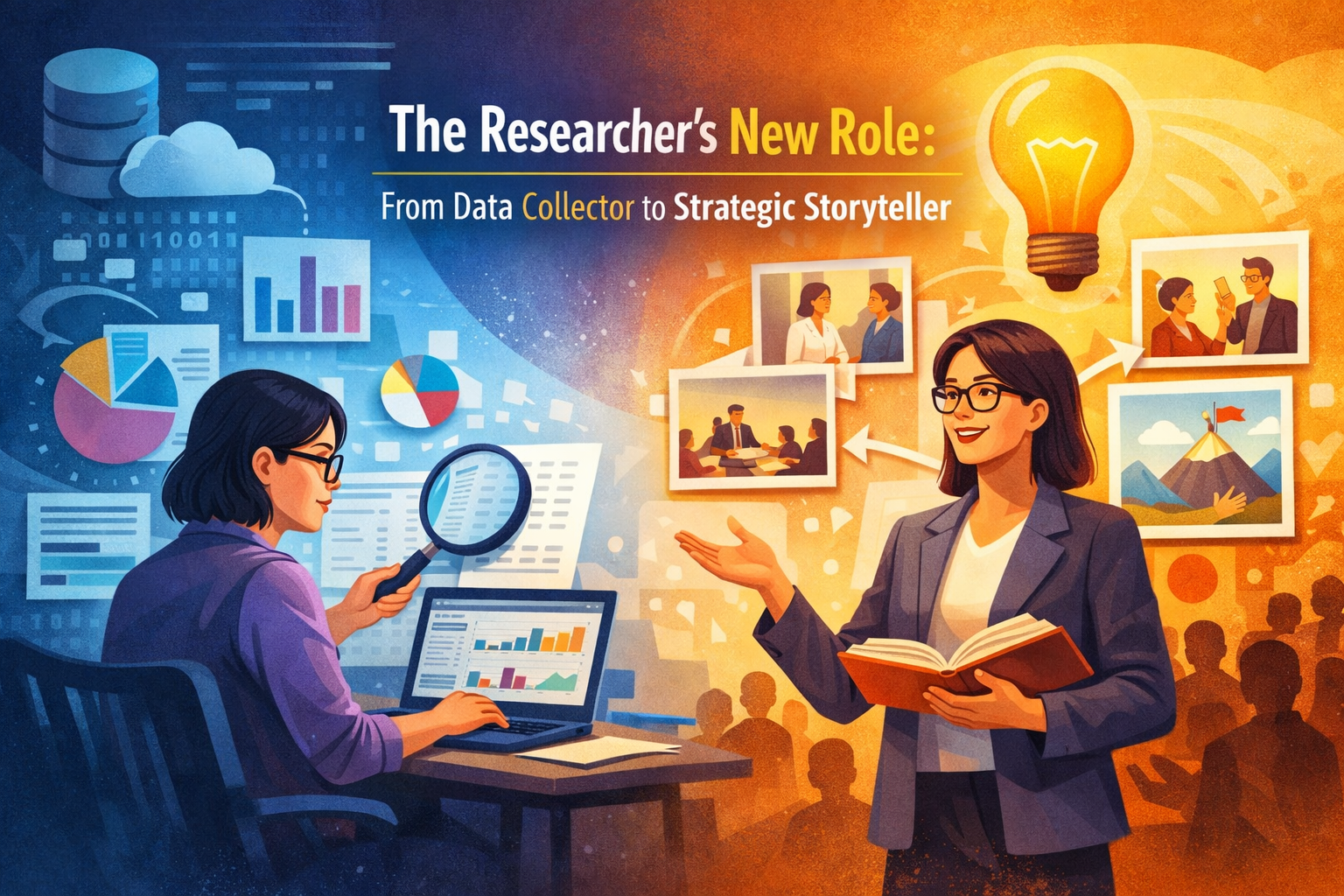
From Running Studies to Driving Strategy
For decades, the role of the researcher was well defined and relatively contained. Design a study. Collect the data. Analyze the results. Deliver the findings. Move on to the next project.
That model worked when data was scarce, timelines were long, and insights teams were the primary gatekeepers of consumer understanding. But today, that version of the researcher is quietly becoming obsolete.
Not because research is less important but because its value is being redefined.
In a world of AI-powered analytics, real-time dashboards, and endless streams of customer data, the modern researcher’s job is no longer just to find answers. It’s to shape decisions. And that requires a fundamental shift from data collector to strategic storyteller.
1. The Old Researcher Model
The traditional research workflow was linear and transactional.
Researchers were tasked with:
- Commissioning studies
- Designing surveys or discussion guides
- Analyzing results
- Delivering findings in a deck or report
- Handing those findings off to stakeholders
Once the presentation was done, the job was considered complete.
This model positioned researchers as service providers, not strategic partners. Their value was tied to methodological rigor and analytical depth not necessarily to business outcomes. Success was measured by how comprehensive the study was, not by whether it changed a decision.
And for a long time, that was enough.
2. Why That Model Is Breaking
Today, the cracks in this approach are impossible to ignore.
Stakeholders expect faster answers
Business leaders operate in compressed timelines. They can’t wait months for insights that arrive after decisions have already been made. Research that doesn’t keep pace with the business quickly becomes irrelevant.
AI and automation are commoditizing data collection
Survey tools, social listening platforms, analytics dashboards, and generative AI can now gather and summarize data faster than ever. The act of collecting data is no longer a competitive advantage.
Insights teams must justify their value
When stakeholders can pull numbers themselves, the question becomes: Why do we need researchers at all?
The uncomfortable truth is this:
If researchers only deliver data, they will be replaced by tools that do it cheaper and faster.
What can’t be automated, however, is interpretation, judgment, and influence.
3. The New Expectation
As a result, expectations of researchers have fundamentally changed.
Today’s most effective researchers act as:
Strategic partners
They’re involved early before the brief is finalized, before the solution is chosen, before the organization commits to a direction. They help frame the right questions, not just answer predefined ones.
Translators between consumers and the business
They connect lived human experiences to commercial realities. They explain not just what consumers do, but why it matters to growth, risk, and opportunity.
Influencers of decisions, not just observers
Their work doesn’t end with insight delivery. It continues until a decision is made or changed because of what was learned.
In this new model, research isn’t a function.
It’s a strategic capability.
4. What Strategic Storytelling Really Means
Storytelling in research is often misunderstood as “making slides prettier” or “adding a quote to the deck.” But strategic storytelling goes much deeper.
It’s about how insights are framed, contextualized, and delivered so they actually move people.
Connecting insights to business stakes
Data alone is neutral. Storytelling links insight to consequence:
- What happens if we ignore this?
- What opportunity are we missing?
- What risk does this behavior signal?
When insights are tied to real stakes, they demand attention.
Framing findings around decisions
Instead of organizing research by themes or charts, strategic storytellers organize insights around choices:
- Should we invest or pull back?
- Should we redesign or optimize?
- Should we launch, delay, or kill this idea?
The insight becomes a guide not a summary.
Making insights memorable and shareable
Executives won’t remember percentages from slide 47. They will remember:
- A striking moment
- A real human story
- A clear tension between expectation and reality
Stories create recall. Recall drives action.
5. Tools That Enable the Shift
The evolution of the researcher’s role is being accelerated by new research approaches and tools that prioritize experience over abstraction.
Visual, participant-led evidence
Photos, videos, voice notes, and screen recordings bring consumers into the room. They replace secondhand summaries with firsthand exposure.
Seeing a behavior is more powerful than reading about it.
Longitudinal and in-context insight
Understanding behavior over time and in real environments reveals motivations that single-point studies miss. It shows how habits form, break, and adapt.
Fewer decks, more moments
Instead of 80-slide reports, leading researchers curate key moments:
- A clip that captures hesitation
- A photo that reveals workaround behavior
- A quote that exposes emotional friction
These moments travel further inside organizations than any spreadsheet ever will.
6. Skills Modern Researchers Need
This shift isn’t just about tools. It requires researchers to develop new skills and mindsets.
Narrative thinking
Researchers must learn to structure insight as a story with context, tension, and resolution not just findings and implications.
Business acumen
Understanding commercial objectives, KPIs, and constraints allows researchers to speak the language of decision-makers.
Comfort with ambiguity
Not every insight is neat or statistically clean. Strategic researchers help teams navigate uncertainty rather than hide from it.
Confidence influencing senior stakeholders
Storytelling is persuasion. Modern researchers must be comfortable holding the room, challenging assumptions, and guiding conversations at the leadership level.
This isn’t about being louder. It’s about being clearer and more compelling.
7. Closing Thought
AI will continue to transform how data is collected, processed, and summarized. But it won’t replace the researcher who understands how to turn insight into influence.
The future researcher isn’t replaced by technology.
They’re elevated by it. Those who evolve from data collectors to strategic storytellers won’t just survive this shift they’ll lead it. Because in an age of infinite data, the real value lies in making meaning, driving decisions, and telling the stories that move organizations forward.